
 Yesterday I decided I couldn't waste such a fine day by sitting indoors and knitting so hopped into the car and drove about 4 miles towards Thame to visit Dinton Church. Despite its nearness to home I've never been to see it though I did know some things about it.
The first thing that greeted me was a vista of molehills - all dug by 'the little gentleman in the black velvet coat'. I have moles, or a mole, in the garden from time to time and you know he's about because plants are leaning over sideways where they've been undermine
As I rounded the corner of the church I could hear singing - Michael Ball and 'Love Changes Everything'. I found the door open and a couple of ladies making flower arrangements for a funeral being held today. They were testing a tape to see if the songs on it would be suitable. For me, it meant that I didn't have to go and find a keyholder if it had been locked.
The Norman door to Dinton Church is well known for the carving on the tympanum above the entrance.

On the lintel it shows a dragon deciding to attack St. Michael who is holding out a small cross. The larger carving shows monsters eating fruit from the ?Tree of Life.

The porch, which helps to shelter this carving, also has some carved corbels. They aren't in very good condition looking as if they've been subjected to weathering over many centuries.


I've seen an etching of the door from the 19th century and there is no porch. Perhaps the church couldn't afford top notch carvers in the first place as they seem to be rather naive faces.
 The stocks used to be on a patch of grass ouside the church boundary but at some point they've been brought into the porch's shelter. I wonder if they had a one-legged trouble maker in Dinton - there are 5 leg holes....
Inside, the church has a high ceiling and it's light and bright unlike Stone church which is stone walled and grey. The pews have kneelers made to different patterns depending on the interests of the maker. This is just a selection and it wasn't an easy choice. They are all hung on hooks on the back of the pew in front.
Dinton font is an example of the 'Aylesbury type' of font, ie, a cup/goblet shape.
 I asked the flower arranging ladies why various items were covered in these blue cases - because there are bats in the church and it stops their deposits from damaging the items, though only certain objects were shrouded like this.
I took a photo of the organ, which is large for a small church but - it wasn't good enough to include. There are some hand worked representations of the village done in wools and materials and framed behind glass - and out of the light.
 The plaque commemorates a member of the Currie family whose home was next door in Dinton Hall. The Curries played a part in the wider district - in 1931 Sir William Currie had attended the opening of Stone's 'vastly improved bowling green'.
  In the spring of 1944 Lt. Currie was killed at Kohima, the furthest point which the Japanese reached in their attempted invasion of India. It was 'the scene of some of the bitterest fighting of the whole Burma campaign.' The road to Imphal was re-opened after huge casualties from hand to hand fighting, where for a time the Deputy Commissioner's tennis court formed a no-man's-land. It has been outlined in white concrete and this is the site of the cemetery. It holds Commonwealth soldiers, Hindu and Sikhs. There is a memorial to the 2nd British Division, a large stone which bears the inscription -
When you go home
Tell them of us and say,
For their tomorrow
We gave our today.
(This information comes from Vol.3 of an Imperial War Graves Commission booklet, pub. 1958, which I picked up in a charity shop many years ago. Its title is TheirName Liveth. )
As I left the church I walked round the exterior and saw this grotesque high on the wall near the roof.
 I'd have called it a gargoyle but I've recently seen a QI programme where the host, Stephen Fry, said gargoyles are for diverting rain water away from the building and this type of carving is known as a grotesque. I believe him!
Dinton Hall was renovated over several years but I don't know what its use is these days; one web site suggested a gentlefolks' home...There is an amazing range of twisted chimneys which in my photo look like a block - I was paying too much attention to the patterning on the roof.
In the time of the Civil War in the mid 17th Century it belonged to Simon Mayne, friend of Cromwell and one of the signatories to Charles I's death warrant. When Charles II returned to England Mayne was incarcerated in the Tower of London but is buried at Dinton. Just along the road is a pub called The Dinton Hermit which used to have a sign of a man in old-fashioned clothes. 
The man was John Bigg, Simon Mayne's clerk. Alison Uttley says, in her Buckinghamshire book, that tradition has it he was Charles I's executioner and, struck with remorse, lived as a hermit. One of his leather shoes, patched, repatched and patched again until it became enormous, is in the Bodleian Library, according to a website. I can't remember whether I've seen it or not...
 Something nice to end on. I walked for about a mile on a flat road and on the way back to the car saw these violets shining in the grass.....


 growing on a stone 'lump' which is supposed to be the base of the church cross.
 According to Alison Uttley's book of Buckinghamshire (rather fanciful reading about life in the good old days) this is meant to be a bishop and the one below represents a king. He looks a bit young to be a king, I think.
 I think they're Scots pines but I have hardly any tree bark knowledge.
 Here's one way of finding the watering can next time it's wanted!


 When the NHS began in 1948 the name changed again to its final designation - St. John's Hospital. Then it was decided by Bucks CC to demolish this vast building for development, ie, housing. The roads on the site are named for the original wards but this Street was named after a doctor who died in WW2, though his name isn't on the war memorial - he's a 'foreigner' from Scotland.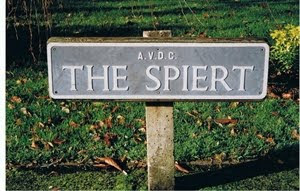

 However, getting older limits what you can do - It's so much trouble struggling to get up that it's not worth trying to kneel down these days, so my gardening is limited to strolling up and down the path with the book during the week making notes about what needs to be done. I can still prune, sweep the path, a short burst of anything that needs attention at ground level but I'm mostly a gofer and tea maker.
 The honeysuckle which covers my trellis arch is sprouting. A couple of weeks ago I asked Stuart to come and oil the weathervane which had been stuck all winter and wondered why he was laughing when he returned. A honeysuckle had wound itself round the upright of the weathervane and, although cut, hadn't been dragged off! Mind you, the weathervane is tilted because the pigeons find it a comfortable perch, the space between the owl's wings just fits their undercarriages.
 The tilt is exaggerated because of where I'm standing - and it's raining!


 I was evacuated to Brighton with the school and this is on the seafront in November 1939 when I'm 7. Another jersey and the usual pleated gymslip and, I would think, the sort of plaited cord which tied round your waist.


 And the text on the plaque.
 Twenty six (or twenty one) year old Clyde Cosper and his crew left their B17 base in Bedfordshire on a mission to bomb the U boat pens at Bremen. Bad weather caused the plane to encounter problems and the pilot ordered the crew to bail out while he stayed at the controls, steering the plane away from the little town of Princes Risborough. It crashed just outside the town and the full bomb load exploded. The pilot was awarded the Air Medal and Purple Heart. Some memorabilia is on show at Wycombe Air Park.